Besspektikers
Axis Code
Axis Code
Couldn't load pickup availability
Self-paced learning overview
- 📦 Digital file available after purchase
- ♾️ Long-term availability
- 🔒 Secure checkout
- 🔄 Content updated in 2026
Problem Statement Many real-world vulnerabilities stem not from complex zero-days but from recurring coding mistakes: improper input handling, weak memory management, insufficient authentication checks. Developers often focus on functionality first, not on how an attacker might abuse the code. You want to learn to spot potential weak points during writing or auditing, understand how to research code for vulnerabilities, and apply secure coding principles in daily work.
Solution This plan helps you systematically understand secure programming principles and vulnerability research methods at the source code level. We go step-by-step through common error classes, how to detect them, how to write harder-to-exploit code, and how to conduct basic vulnerability research.
What's Inside
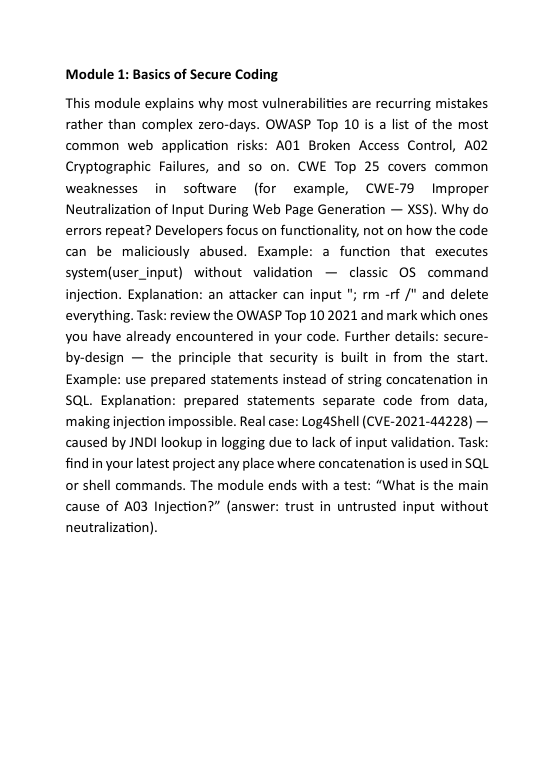
- Module 1: Secure coding fundamentals — OWASP Top 10 and CWE Top 25, why they occur, how they link to real attacks.
- Module 2: Input/output handling — injections (SQL, OS command, LDAP, XPath), XSS, deserialization; proper sanitization and validation across languages.
- Module 3: Memory management and buffer overflows — off-by-one, use-after-free, integer issues; avoiding them in C/C++, checking in GC languages.
- Module 4: Authentication and authorization — weak passwords, session fixation, broken access control; correctly implementing JWT, OAuth, RBAC/ABAC.
- Module 5: Cryptographic mistakes — improper hashing, weak algorithms, side-channels; using modern primitives correctly (Argon2, ChaCha20-Poly1305, etc.).
- Module 6: Basic vulnerability research — static code analysis (SAST), reading patch diffs, fuzzing basics, simple binary reverse engineering, vulnerability pattern search.
- Module 7: Practical scenarios and audits — dissecting real CVE examples (anonymized), how the bug looked in code, how it was found, how to fix and prevent recurrence.
- Additional materials: language-specific secure coding checklists, vulnerable vs fixed code examples (Python, JavaScript, Go, C), code review templates, bug-finding exercises on provided snippets.
Who is this for?
✅ Perfect if you already write code (backend, frontend, systems), have experience with cloud or endpoints, and want to add a security layer directly at the code level.
❌ Not for you if you don’t yet write serious code or are just starting in cybersecurity — complete Luma Stage or Cloud Plan first for context.
What You'll Learn (specific skills)
- Detect and prevent common injections and XSS during coding.
- Write safe input handling using prepared statements, escaping, content security policy.
- Understand memory risks and apply safe patterns (e.g., RAII, smart pointers).
- Implement reliable authentication and authorization without common pitfalls.
- Use modern cryptographic primitives correctly and avoid deprecated algorithms.
- Perform basic static code analysis and search for vulnerabilities in patches or repositories.
- Analyze real CVE examples and apply lessons to your own code.
This plan is built for developers and researchers who want to embed security directly into the coding and review process. Most exploited vulnerabilities are predictable mistakes that can be systematically spotted. The materials contain hundreds of code examples: vulnerable fragment → explanation of danger → fixed version → exploitation test (where safe). For instance, in the injection module we show how skipping one parameter in a prepared statement leads to SQLi, how it appears in database logs, and how ORMs can help or hide issues. In memory sections — buffer overflow examples in C, how they lead to RCE, and how modern mitigations (ASLR, canaries, DEP) complicate but don’t eliminate the problem. In research you learn to scan commit history, search for risky functions (strcpy, system(), eval), use tools like semgrep or CodeQL for basic rules.
Guarantee - 30-day money back
Whatformat are the course materials?
Whatformat are the course materials?
All courses consist of step-by-step lessons, text explanations, diagrams, code examples, and practical exercises. Materials are available in PDF after
purchase and can be studied at your own pace.
Areprior knowledge required to start?
Areprior knowledge required to start?
Each plan has its own difficulty level — from basic to more advanced. The
description indicates who the material is suitable for (e.g., beginners or
those with basic skills already).
Howlong is access to the materials?
Howlong is access to the materials?
After purchase, you get lifetime access to the updated materials of the chosen plan.
CanI get a refund?
CanI get a refund?
If the materials do not match the description or there are technical issues with access — write to us within 30 days, and we will review the situation
individually.
Share